
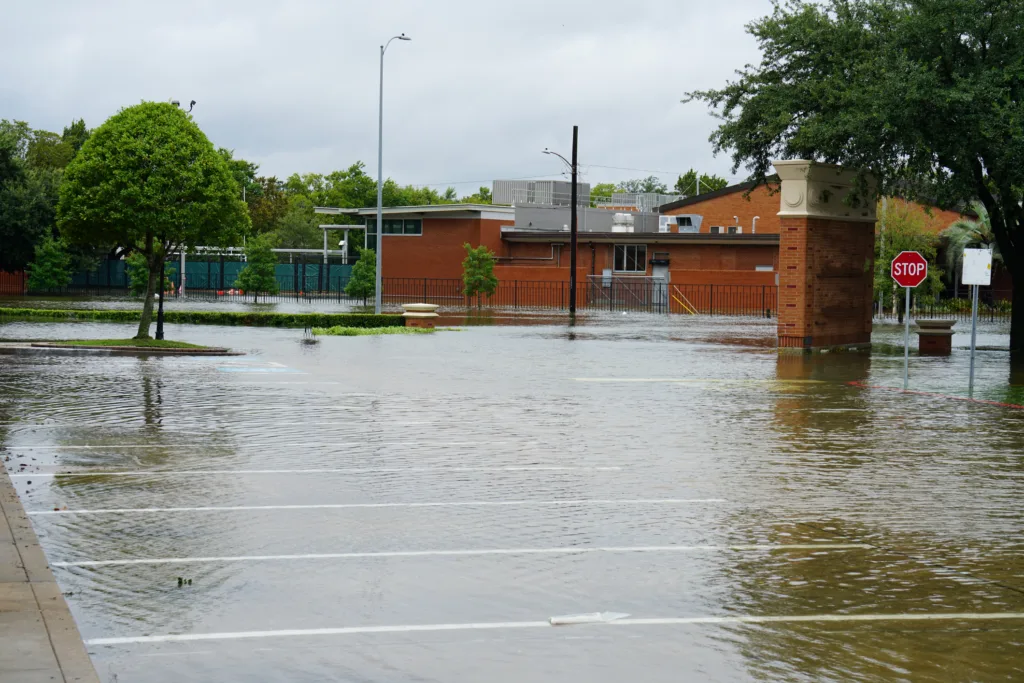
Key Takeaways:
- Flood barriers are not standalone solutions. Flood planks cannot protect buildings that are not structurally dry flood proofed – improper use can redirect water pressure and cause severe structural damage.
- Hydrostatic pressure is the critical risk factor. Unreinforced building slabs can fail under minimal water depth, meaning flood barriers may increase risk rather than reduce it when systems aren’t properly integrated.
- Compliance with federal regulations is essential. Flood mitigation strategies must align with 44 CFR Part 60; misuse of flood barriers can violate federal law and jeopardize access to the National Flood Insurance Program.
- Education-driven leadership shapes better outcomes. PS Flood Barriers® prioritizes informed decision-making over product sales, influencing policymakers and helping communities adopt safer, code-compliant flood mitigation strategies.
There’s an old saying that goes “a man who wants to lead the orchestra must turn his back on the crowd.” This also applies to business, of course, and recently a member of the PS Flood Barriers team got an opportunity to put these words into action.
The Deft Group is a national risk management and claims consultancy specializing in commercial and high-net worth properties. For example, they work as intermediaries between condo associations and insurance companies. Recently, they held an event called the Deft Resilience Summit in St. Petersburg, Florida. Materials for this event included this description: Fortifying the Future: Navigating Catastrophe, Climate and Coverage, and one of the panel discussions was entitled “Flood Mitigation Strategy.”

PS Flood Barriers’ own Guy Hamilton was asked to take part in that panel. Not only is Guy an important part of the PS Flood Barriers sales team, he also has many decades of experience working with Florida businesses and property owners as they navigate the state’s complex intersection of local, state and federal laws and codes, as well as some of the most unpredictable and destructive hurricane weather in North America.
Also on the panel was a representative from another national flood solution manufacturer. A rep from a third flood prevention product manufacturer was in the audience. The industry was well represented, but questions about the use of flood planks soon changed the direction of the entire discussion.
At the core of this shift was Guy Hamilton himself. “The topic came up about whether flood planks can help if the rest of a building – a house, a factory, you name it – isn’t already dry flood proofed. The answer is, no, not according to federal law.”
It was surely an unexpected response from a man representing one of the country’s most respected manufacturers of flood control solutions. After all, it might seem to be in Guy’s best interest to simply suggest a PS Flood Barriers product.
But Hamilton doesn’t see it that way. “We’re leaders in this industry,” he says, “and that means we need to help communities make good decisions about flood proofing and mitigation. Protecting people and property comes first, not selling our products.”
Hamilton proceeded to explain why installing flood barriers on a structure that is not structurally flood proofed is more than just foolhardy, it can potentially be dangerous to both people and property.
“When it comes to water, think of a building like a boat. If you have everything sealed up, flood barriers can keep water from entering openings like doors and windows just like hatches keep water from inside a boat. However, just like on a boat, most of the hydrostatic pressure from floodwaters come from underneath, so if the slab that the building is on isn’t constructed to withstand the massive power that water brings to bear, then the boat floats – or in the case of a building – the slab rises up and cracks, oftentimes damaging the rest of the building as well.
“The typical 4″ slab under a building that has not been reinforced to handle hydrostatic pressure can only withstand about eight inches of water before it gives way. Why then, should we think that installing flood planks that are made to keep out four feet of water will not have consequences. All that pressure just redirects to the rest of the building. If the building has other openings in it, like those for the wires, hoses and pipes used by utility companies, for example, the water is forced into the building through those gaps. If those holes are sealed, the water just applies pressure everywhere else, almost always resulting in significant structural damage.”
“If your structure, whether it is a commercial building, a condo or a residential home, isn’t flood proofed as it is being constructed, flood planks can’t protect it,“ says Hamilton. “You’re better off thinking about how you can mitigate the damage or protect important infrastructure.”
Federal laws also play a part in whether a building can utilize flood planks for protection. “44 CFR (Code of Federal Regulations) part 60 spells out how and when dry flood proofing is possible, depending on the type of building, the location of the structure, etc.,” says Hamilton. “It’s not just irresponsible to sell flood planks to a misinformed property owner, many times its against the law. If a community doesn’t enforce those codes, they could lose access to the National Flood Insurance Program.”
That kind of language caught the ear of lawmakers in attendance from nearby Ft. Meyers Beach, Florida. Almost immediately, they enacted new guidelines that put significant restrictions on the usage of flood planks.
Counter to what you might believe, these restrictions are good news to Guy Hamilton and the team at PS Flood Barriers. “People believe that a flood barrier will magically work to protect their house or building,” Hamilton says, “but that can be a serious miscalculation.”
Instead, PS Flood Barriers relies on facts, data and the truth to reinforce its flood barriers. “Ask us, and we’ll help you to determine if flood proofing is possible,” says Hamilton, “and if it’s not, how we can mitigate the damage from flooding instead. No matter what, PS Flood Barriers can help you to plan for and overcome the results of flooding, whether it’s expected or unexpected.”
You can learn more about 44 CFR 60 here (www.govinfo.gov/app/details/CFR-2011-title44-vol1/CFR-2011-title44-vol1-part60), and if you have questions about the best flood solutions for your property, contact the team at PS Flood Barriers. We share your values, and we have the experience to spell out the pros and cons of different flood proofing methods in different situations and with different structures. Click here to contact us or give us a call at 877-446-1519.